
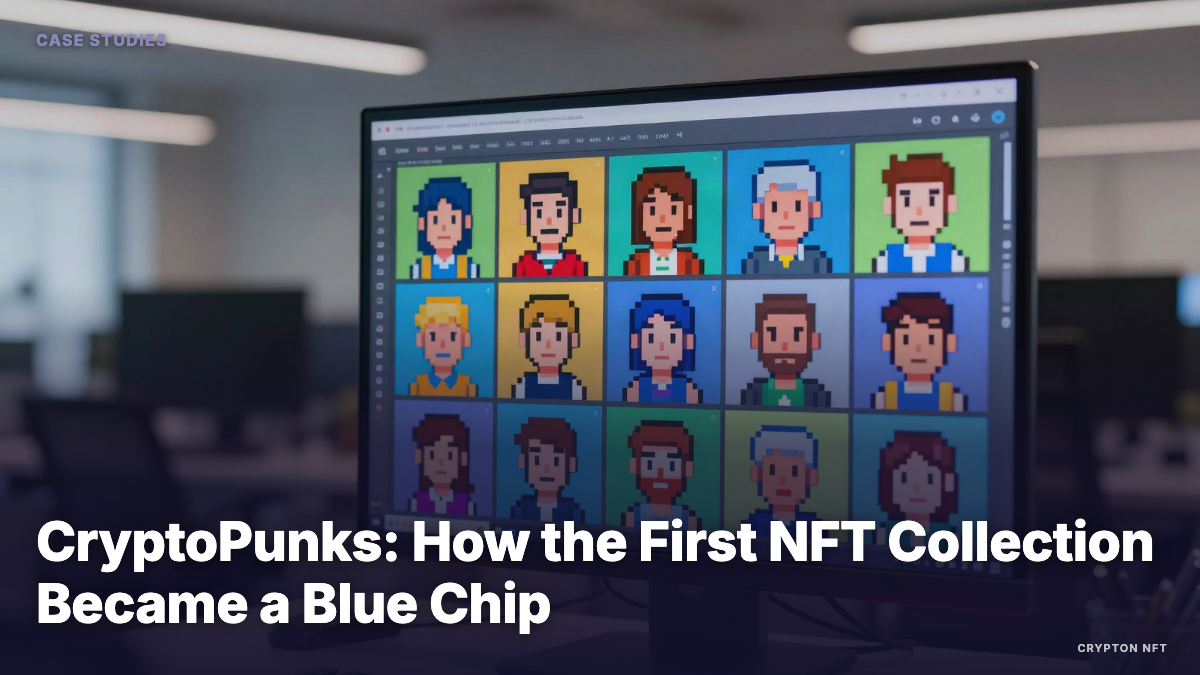
Quick answer: CryptoPunks launched in June 2017 as a free experiment by two-person studio Larva Labs, founded by Matt Hall and John Watkinson. Anyone with an Ethereum wallet could claim one of 9,000 public punks for the cost of gas alone; for months, almost nobody did. The project predates the ERC-721 standard that later formalized how NFTs work, so its creators effectively wrote an early version of it themselves, which is why its early provenance carries weight no newer collection can replicate. Prices climbed dramatically after 2021, with a rare Alien-type punk selling for roughly $23.7 million in February 2022 in a verifiable transaction; a later reported $56 million sale was flagged by analysts as likely involving a flash loan rather than real capital. In March 2022, Yuga Labs, the company behind Bored Ape Yacht Club, acquired the CryptoPunks IP from Larva Labs, folding it into the same commercial ecosystem.
How it started
Larva Labs, founded by Canadian developers Matt Hall and John Watkinson, built CryptoPunks as a side project inspired by London’s punk scene, cyberpunk aesthetics, and electronic acts like Daft Punk. The collection consists of 10,000 algorithmically generated 24×24 pixel characters: mostly humans, with rarer zombies, apes, and aliens mixed in. Larva Labs kept 1,000 punks for themselves and released the remaining 9,000 free to anyone willing to pay the Ethereum network’s minting gas fee, which at the time amounted to a few dollars.
For months, almost nobody claimed them. Early accounts from the project describe a “deafening silence” after launch; the idea of paying real money, even just gas, for a JPEG-like image was not yet a concept most people understood or wanted.
Why it eventually caught on
CryptoPunks predates the ERC-721 token standard that later formalized how NFTs work; the project’s creators effectively wrote an early version of the standard themselves to make it possible. That timing matters for the case study: CryptoPunks isn’t just an early NFT collection, it’s one of the collections whose existence shaped what an NFT even became. Provenance from that period carries weight that no newer collection can replicate, since it can’t be created retroactively.

What the sales history looked like
By 2021, as broader NFT interest exploded (helped along by high-profile sales like Beeple’s $69 million Christie’s auction), CryptoPunks prices climbed dramatically. A rare Alien-type punk, #5822, sold for 8,000 ETH (about $23.7 million) in February 2022, making it one of the most expensive NFT sales on record at the time using verifiable, non-circular funds.
A later sale of punk #1563 was reported at roughly $56 million in October 2024, but blockchain analysts flagged it as likely involving a flash loan, an uncollateralized transaction that inflates the reported price without real capital changing hands beyond network fees. It’s a useful reminder for anyone researching NFT sales data: headline numbers don’t always reflect an arm’s-length transaction, and it’s worth checking whether a sale was independently verified before treating it as a market benchmark.
The acquisition by Yuga Labs
In March 2022, Yuga Labs, the company behind Bored Ape Yacht Club, acquired the CryptoPunks and Meebits intellectual property and art from Larva Labs. This gave Yuga Labs control over one of the space’s foundational collections and folded CryptoPunks into the same commercial ecosystem as Bored Ape Yacht Club, a consolidation that reflected how much of the “blue chip” NFT market had come to be controlled by a small number of players by that point.
Why this case study matters for buyers today
CryptoPunks illustrates two things that hold up regardless of where NFT prices go: first, that being early to a genuinely novel technical standard can create value that’s difficult to replicate later, and second, that headline sale prices need scrutiny, not blind trust. Anyone researching a collection’s price history should check whether reported sales are independently confirmed, the same way you’d check a used car’s listed price against what it actually sold for.
For a look at how a different blue-chip collection built its value, see our Bored Ape Yacht Club case study.
Leave a Reply