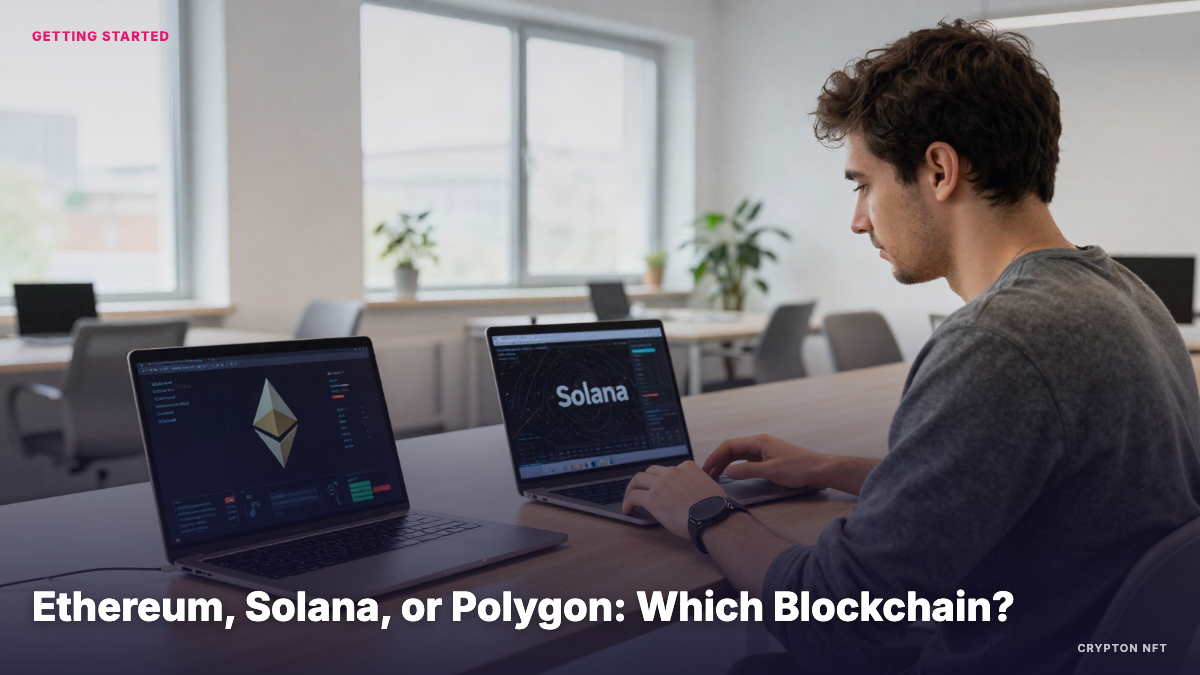
Quick answer: Ethereum has the deepest liquidity and the most established collections, but fees can spike. Solana is fast and cheap, built for high-volume trading and gaming NFTs. Polygon runs as a low-cost layer on top of Ethereum, a good middle ground for beginners who want low fees without leaving the Ethereum ecosystem entirely. Most collectors end up holding wallets on more than one.
Why the blockchain you pick actually matters
Before you buy an NFT, you need cryptocurrency, and the blockchain you choose determines which crypto you need, what fees you’ll pay, and which marketplaces and collections are even available to you. This isn’t a purely technical decision. It shapes your entire experience as a buyer.
Ethereum
Ethereum was the first blockchain to support NFTs at scale and still hosts most of the collections with genuine trading history and name recognition. If you’re buying a well-known collection, there’s a good chance it’s on Ethereum.
Good for: buyers prioritizing established collections, long trading history, and the widest marketplace selection.
Watch for: gas fees. A single transaction can cost anywhere from a few dollars to well over $50 depending on network activity. Layer-2 solutions have reduced this pressure somewhat, but Ethereum mainnet itself remains the most expensive of the three chains covered here.
Solana
Solana processes transactions in a fraction of a second for a fraction of a cent. That speed made it the default choice for high-volume NFT trading, gaming projects, and collections that mint tens of thousands of items at once.
Good for: active traders, gaming and utility NFTs, anyone put off by Ethereum’s fees.
Watch for: Solana has had network outages in the past that temporarily halted transactions. It’s also a smaller, younger ecosystem than Ethereum, so due diligence on any given project matters more.
Polygon
Polygon operates as a scaling layer connected to Ethereum, offering transaction fees that are a tiny fraction of Ethereum mainnet costs while still settling back to Ethereum for security. A number of major brands have chosen Polygon specifically for consumer-facing NFT drops, precisely because low fees make small purchases practical.
Good for: beginners who want to stay Ethereum-adjacent without mainnet gas costs, brand and loyalty-program NFTs, casual buyers making smaller purchases.
Watch for: fewer blue-chip collections than Ethereum mainnet, since most high-value collectors still gravitate toward the original chain.
| Blockchain | Typical fees | Best for | Ecosystem maturity |
|---|---|---|---|
| Ethereum | High, variable | Established collections, resale value | Most mature |
| Solana | Very low | Speed, gaming, high-volume trading | Growing, some outage history |
| Polygon | Very low | Low-cost entry, brand drops | Ethereum-linked, growing |
Do you need to pick just one?
No, and most active collectors don’t. It’s common to keep a MetaMask wallet configured for both Ethereum and Polygon, plus a separate Phantom or Solflare wallet for Solana. Each wallet only holds the crypto and NFTs native to its own chain, so there’s no real downside to running more than one, beyond keeping track of a second seed phrase to store securely.
How to actually get started
Once you’ve decided which chain fits what you want to collect, the next step is acquiring the right cryptocurrency to fund your wallet. A centralized exchange is usually the simplest entry point for a first-time buyer.
OKX and MEXC both support buying ETH and SOL directly with a card or bank transfer, then withdrawing to your own wallet in a few minutes.
Compare exchangesIf you’re still deciding where to actually buy the NFT itself once your wallet is funded, see our comparison of OpenSea, Blur, and Magic Eden, which breaks down which marketplace fits which chain.
Leave a Reply