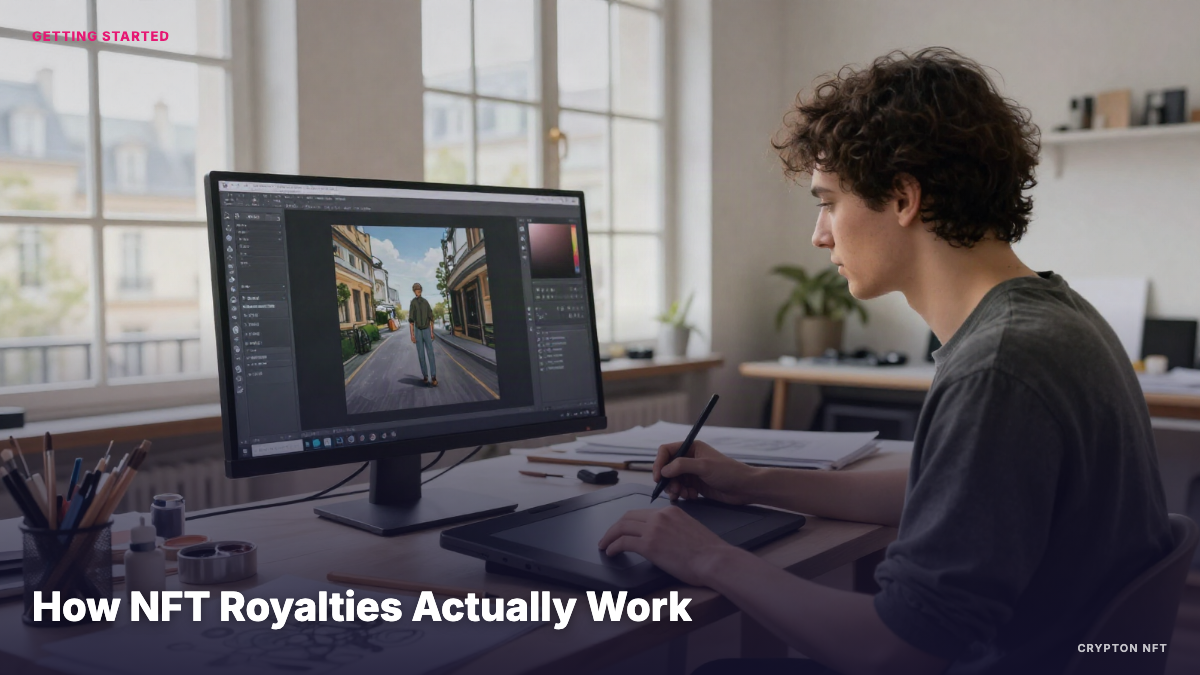
Quick answer: NFT royalties are a percentage of every resale, usually between 2.5% and 10%, that’s meant to go back to the original creator automatically. They worked well in the early days because most trading happened on marketplaces that enforced them. Since 2023, several major marketplaces made royalties optional, so a lot of creators now get paid far less often than the original design intended.
The idea behind royalties
Traditional artists don’t get a cut when their work resells at auction. NFT royalties were pitched as a fix for that. Because ownership and every resale are recorded on the blockchain, a smart contract can automatically route a percentage of each sale back to the creator’s wallet, indefinitely, without anyone needing to track it manually.
For a while, that’s exactly how it worked. Marketplaces read the royalty percentage from the collection’s smart contract and simply deducted it at the point of sale.
What changed
Marketplace competition changed the incentives. Trading platforms started competing on fees, and enforcing creator royalties made a marketplace’s effective cost higher than a competitor who didn’t. Starting around 2023, several major platforms made royalty payments optional for buyers, letting them choose to pay 0% at checkout if they wanted to.
The result: royalty revenue for most creators dropped sharply, even on collections that technically still have a royalty percentage written into their contract. The contract states the rule. Whether it’s actually paid now depends on which marketplace the sale happens on and whether the buyer opts in.
How to check if a collection still pays out
There’s no single universal indicator, but a few checks help:
- Look at the collection’s official page on the marketplace you’re using. Most now display the royalty rate the creator has set, alongside a note on whether it’s enforced or optional.
- Check the project’s own website or Discord. Established creators are usually vocal about which marketplaces still honor their royalty settings, since it affects their income directly.
- Some newer collections use enforcement tools built directly into their smart contract, which technically block a transfer unless the royalty is paid. These are less common but do exist.
What this means if you’re buying
For a buyer, none of this changes how you use or hold an NFT. Royalties are deducted automatically at the point of sale, before the funds reach you or the seller, so there’s nothing extra for a buyer to configure. The one place it matters is if you’re deciding between two similar marketplaces for the same purchase: one might route a royalty payment to the creator and the other might not, even though your total cost could end up similar either way once trading fees are factored in.
What this means if you’re creating
If you’re minting your own collection rather than buying, don’t assume the royalty percentage you set in your contract guarantees income. Read the fine print of whichever marketplace you’re launching on, and understand that enforcement is now the exception on most platforms, not the rule. Some creators have moved toward alternative models, like reserving a percentage of the initial mint supply for themselves instead of relying on secondary royalties.
The bottom line
Royalties still exist as a mechanic, but “the collection has a 5% royalty” no longer means what it did in 2021 and 2022. Whether that 5% actually gets paid depends entirely on where the trade happens. If you’re comparing marketplaces for buying or selling, our OpenSea vs. Blur vs. Magic Eden guide covers how each platform currently handles this.
Leave a Reply